What you need to know about third party litigation funding (TPLF)
Lorem ipsum dolor sit amet, consectetur adipiscing elit, sed do eiusmod tempor incididunt ut labore et dolore magna aliqua. Ut enim ad minim veniam, quis nostrud exercitation ullamco laboris nisi ut aliquip ex ea commodo consequat.
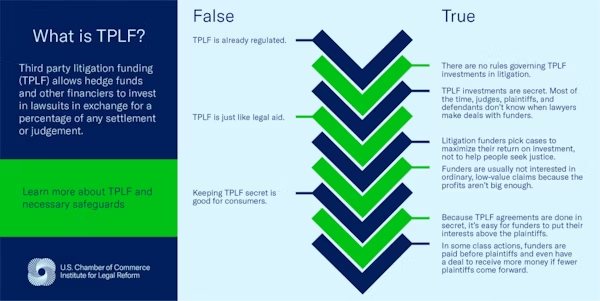
Third party litigation funding (TPLF) allows hedge funds and other financiers to invest in lawsuits in exchange for a percentage of any settlement or judgment. The practice started in Australia, expanded to Europe and the U.S., and is now spreading elsewhere. Without disclosure requirements and other commonsense safeguards, these funders may take over litigation and fuel unmeritorious lawsuits.
Third party litigation funding (TPLF) is the process where third party funders provide money to a plaintiff or plaintiff’s counsel in exchange for a cut of the proceeds resulting from the underlying litigation or settlement. They typically involve a funding agreement that contains the funder’s identity, investment amount, payment schedule, and whether the funder may exercise any strategic control over the litigation.
Litigation funding is typically divided into two main groups: consumer and commercial or investment. Consumer litigation funding arrangements generally involve a plaintiff seeking financial support from a funder for living or other expenses, usually related to tort or personal injury claims. Alternatively, investment or commercial litigation funding arrangements often involve large–scale tort and commercial cases and alternative dispute resolution proceedings. Moreover, investment /commercial funding arrangements may involve a single-case or multiple cases (i.e., portfolio funding).
Typically, these arrangements are non-recourse, meaning that if the plaintiff’s suit is unsuccessful, then the funder receives nothing.
Traditionally, the common law doctrines of maintenance and champerty prohibited non-parties from financing litigation, but recently some jurisdictions have relaxed these outright prohibitions.
FAQs
It is difficult to tell the exact size of the litigation funding industry because very few jurisdictions require the disclosure of litigation funding agreements.
TPLF started around the mid-1990s in Australia and quickly spread across the globe, arriving in the United States about a decade later. In recent years, TPLF has experienced explosive growth and is now a multi-billion-dollar industry worldwide, with an estimated $15.2 billion in commercial litigation investments in the United States alone.
TPLF is problematic for a variety of reasons.
Allowing outsiders to secretly use courtrooms as a trading floor incentivizes the filing of non-meritorious litigation. Litigation is extremely expensive, and businesses seek to avoid it. Businesses often settle cases rather than engage in protracted and costly litigation, regardless of whether the claims are legitimate. Since TPLF lets plaintiffs off the hook for legal costs, there is little risk for them to advance non-meritorious claims.
When companies face higher litigation costs, they are often forced to raise prices for consumers. Furthermore, TPLF can corrupt the legal system by prioritizing profit over justice, putting the investment interests of funders ahead of the interests of others, including the plaintiffs themselves. In essence, TPLF can weaken the fairness and integrity of the legal system and negatively impact the economy.
TPLF allows funders to exercise undue control or influence over the litigation to the detriment of courts, defendants and plaintiffs. For example, in some TPLF agreements, there are provisions that allow funders to make strategic decisions like whether and when to settle, even if the plaintiff would rather proceed to trial. Unlike attorneys, funders do not owe a fiduciary duty to the plaintiffs and may not be acting in their best interest.
TPLF often contravenes the Model Rules of Professional Conduct, which are designed to ensure that lawyers act in the best interest of their clients. For example, rule 5.4 prohibits fee-splitting between a lawyer and a nonlawyer. Certain TPLF agreements violate Rule 5.4’s fee-splitting provision because funders are paid a percentage of the legal fees secured by the plaintiff’s attorney. Rule 5.4 also prohibits nonlawyers from having an ownership interest in law firms. Some litigation funders would like to abolish Rule 5.4 to acquire ownership interests in law firms to streamline funding.
Disclosure is important because litigation funding agreements are generally kept secret. As a result, nobody knows what control or influence the funders have over the underlying litigation or attorneys. In most cases, knowing whether there is TPLF in any given case is impossible. Requiring the disclosure of TPLF agreements would bring to light many of the previously discussed issues and incentivize funders (and attorneys) to behave ethically.
Litigation funders identify cases where there is likely to be a large award and arrange with law firms or plaintiffs to pay the litigation costs in exchange for a share of the outcome. Funders also engage in “portfolio funding,” in which they purchase a contingent interest in the outcome of a whole portfolio of lawsuits. The involvement of TPLF in litigation raises a host of ethical issues.
TPLF Takeaways
Once a funder decides to finance a lawsuit, they will enter into a litigation funding agreement with the funded party, usually a law firm or plaintiffs’ lawyer. There is often no mandatory disclosure of these agreements. This means that judges, defendants, and even plaintiffs (particularly in class actions) may not know that a hidden third party has a stake in—and an expectation to profit from—the case in front of them.
ILR has been warning about the need for transparency because everyone involved in a lawsuit should know who is funding it and calling the shots in the litigation and where exactly that money is coming from. In 2022, ILR released research that pointed out how the lack of safeguards around TPLF could have serious national security implications. There’s nothing stopping adversarial governments from using litigation funding to pour money into cases against American companies, including defense and other sensitive industries, in order to tie them down in litigation, make them spend money, or access their intellectual property.
Headlines show that ILR is right to have concerns. Bloomberg Law recently published a bombshell article exposing how an investment firm established by sanctioned Russian billionaires with ties to Vladimir Putin has funded lawsuits in the U.S. and UK to evade international sanctions. Last year, PurpleVine IP, a Chinese third-party litigation investment firm, financed multiple intellectual property lawsuits in U.S. courts against Samsung and a subsidiary. The only reason we are aware of this funding is because the Chief Judge of the U.S. district court in Delaware, where one of the lawsuits was filed, has a standing order requiring disclosure of all litigation funding in his courtroom. The plaintiff in that case has since acknowledged that PurpleVine is funding three similar cases in federal court in Texas.
The increasing use of third party funding in U.S. patent lawsuits poses a threat to national security, too. This practice, which now plays a role in about 30% of the country’s infringement cases, hides the identities of those funding and controlling these lawsuits. This secrecy could allow foreign adversaries to benefit from influencing the American legal system.
For instance, in the case between Intel and VLSI Technology—a company supported by a hedge fund linked to Abu Dhabi and opposed to disclosing its litigation funding sources— the dispute was over claims that Intel’s microprocessors violated VLSI’s patents. This legal clash not only takes away resources from Intel’s crucial work in semiconductor innovation and production, vital for the U.S. economy and military technology, but also raises worries about undisclosed foreign participation in lawsuits that could harm U.S. interests.
The lack of transparency in third party litigation funding, especially when companies like VLSI refuse to reveal who is backing them, highlights the need for measures to ensure the public knows who is using our courts.
In December 2022, 14 state attorneys general (AGs) sent a letter to the U.S. Department of Justice (DOJ), asking U.S. Attorney General Merrick Garland and other top officials about the steps being taken to protect the country against potential national security threats posed by TPLF. In January 2023, Senator John Kennedy sent a similar letter. And in November 2023, Senators Marco Rubio (R-FL) and Rick Scott (R-FL) wrote to the chief judges of Florida’s federal district courts urging those courts to adopt disclosure requirements for foreign-sourced TPLF.
If a third party has a financial stake in a lawsuit, it will naturally want to control or influence the lawsuit, sometimes to the detriment of the actual party in interest. Funders often design funding agreements to maximize their chances of success and their profits. They will want to influence the strategic decisions of the funded party in litigation, including fundamental issues such as selecting a lawyer, choosing an expert witness, accepting or rejecting a settlement agreement. Furthermore, when lawyers depend on funders to get paid or count on their financing in future cases, they may face pressure to let the funders have their way. This creates a power dynamic that can undermine the interests of the plaintiffs in the case and the proper working of the courts.
The legal battle between Sysco and Burford Capital highlights this issue. Sysco accused Burford Capital, its litigation financier, of blocking reasonable settlement offers in its antitrust case, effectively trapping Sysco in a lawsuit it wished to settle. Burford Capital then attempted to replace Sysco as the main party in the lawsuit. However, a court ruling has rejected Burford’s attempt to take Sysco’s place. It is crucial to establish transparency and oversight of TPLF so that funders cannot hold plaintiffs hostage in their litigation.
Funding agreements also lay out how exactly the funder will be paid. In many known instances, when the plaintiff wins a funded case, the funder will first take its cut of the winnings before the plaintiff is paid—often 20-40% of the proceeds of the case, or even more. These arrangements can leave plaintiffs (particularly in class actions) with little or no money, especially if the lawyers also take a contingency or large winning fee.
Third party funders generally don’t have to abide by any ethical or fiduciary rules. Their priority is their financial investment, not the best interests of the plaintiffs. In fact, in some funded class actions, the funding agreements are structured so that the fewer people who claim their award, the more money the funder gets.
PBS aired a gripping, true-life story of a legal system run amok. “Mr. Bates vs. The Post Office,” which first aired on Britain’s ITV, shows how a group of British postmasters were doubly abused—first by false accusations of theft and accounting fraud that left many in financial ruin or prison; second, by a lawsuit where litigation funders and plaintiffs’ lawyers took more than 80 percent of the settlement before the postmasters saw one penny. While the specifics of the postmasters’ plight are unique, the abuses in this real-life example of TPLF show how hedge funds and other financiers secretly invest in and control lawsuits in exchange for a high percentage of the settlement to the detriment of claimants.
Litigation funding, at a minimum, should be disclosed and subject to fair and proportionate safeguards like other financial and legal professions to prevent litigation abuse and ensure adequate compensation to plaintiffs.
A survey released by ILR shows that 69 percent of voters, including strong majorities of Republicans, Democrats, and Independents, support requiring the disclosure of TPLF. The survey also shows that 82 percent of voters across the political spectrum oppose allowing foreign governments to invest in U.S. lawsuits against American companies. A recent ILR report, ILR Briefly: A New Threat: The National Security Risk of Third Party Litigation Funding, found:
There is a growing concern that a large volume of foreign-sourced money may be pouring into U.S. civil litigation against U.S. companies and industries (including those in defense and other highly sensitive sectors).
A foreign government could fund litigation to advance its strategic interests against the U.S.
Though the U.S. government has taken action to limit foreign access to U.S. technology, there is no measure currently in place to prevent foreign adversaries from using TPLF to circumvent existing safeguards.
In some countries, like the UK, funders claim to abide by self-regulation through voluntary codes of conduct. Unfortunately, the self-regulation of TPLF is fraught with numerous problems that undermine its effectiveness. According to a report by Fair Civil Justice, self-regulation lacks enforceable standards and sanctions, allowing funders to operate without accountability or consequences for unethical practices. The voluntary nature of such regulation means that many funders can simply opt out, leaving a significant portion of the industry unregulated. Additionally, self-regulation often fails to address conflicts of interest and the potential for funders to exert undue influence over litigation, compromising the integrity of the legal process. Self-regulation of TPLF falls fall short in protecting the interests of plaintiffs and the justice system as a whole. Mandatory oversight and safeguards of the funding industry are needed.
TPLF Research
The Institute for Legal Reform’s research program is cutting-edge. We examine the most pressing civil justice issues facing legal systems across the world. We work with some of the world’s foremost legal experts to offer insights and potential solutions for a more just legal system.
Entities that advance money to plaintiffs or law firms to cover litigation or other costs on a non-recourse basis contingent on the outcome of the case. According to the Government Accountability Office, many are private institutions that specialize in TPLF, some are publicly traded, some are hedge funds and many receive capital from various sources such as sovereign wealth funds, pension funds and endowments. They are not parties to the lawsuit.
The contract that sets forth the terms of the funding arrangement. Generally, these documents are not required to be disclosed. Still, some courts and states have implemented disclosure requirements either through adopting a court rule or passing legislation (e.g., the Federal District of New Jersey, Northern District of California for class actions, Federal District of Delaware, and Wisconsin).
Typically done in one of two ways: in camera (i.e., disclosed only to the judge) or between the parties (i.e., disclosed to the opposing party). Disclosure allows the court and parties to know the identity of the litigation funder and may help determine whether the funders are exercising undue influence, violating any ethical rules, or whether conflicts of interest exist.
This means that if no recovery is made from the dispute, the borrower is not obligated to repay the funder.
Litigation funders finance multiple cases belonging to a lawyer or law firm, with the return on invested capital coming from the settlement or judgment of any individuals or group of cases. Portfolio funding allows the litigation funder to essentially bankroll all or a portion of a law firm’s case in exchange for a cut of any proceeds. This practice makes litigation funding less risky by allowing funders to spread their risk over multiple cases.
An old English law doctrine that prohibits third parties from providing financial assistance to a claimant for a financial interest in the outcome of a dispute. While this doctrine is limited in some states, it does remain in multiple jurisdictions.
Prohibits a third party from “intermeddling” with another’s lawsuit. Like champerty, it has been limited in some states but remains in others.