
Updated
September 12, 2026
Published
February 27, 2023
This Week's Highlights
- Main Street Headwinds: Anticipation of high prices and uncertainty are stifling plans for growth.
- 2026 Outlook: Retailers and restauranteurs are looking to achieve profitability through efficiency.
- Summary: Small businesses remain resilient in the face of high prices, but growth remains muted due to inflation and uncertainty.
Small businesses remain resilient and optimistic in the face of high prices. Small employers are looking to achieve profitability through efficiency.
Tariff Refund FAQ Guide: Visit this guide for information to help small businesses identify whether they paid IEEPA‑based tariffs and prepare for the emerging refund process.
Navigating the New Tax Law: Don't miss our practical guide to maximizing savings for small businesses under the “One Big Beautiful Bill Act.”
ICYMI: As the United States celebrates its 250th anniversary, U.S. Chamber of Commerce President and CEO Suzanne P. Clark unveiled a bold vision for how the business community can help shape the nation’s next chapter. Watch here.
Is your small business a member of the U.S. Chamber? As the nation's leading small business advocacy organization, we can help you with exclusive intelligence and access, a Policy Help Desk, regular updates on economic and business trends, and more.
New Small Business Data
Mastercard Dreamononics Report (September 15, 2026)
Insight Summary: Use of digital tools to bolster growth is becoming a global method for small businesses.
- 67% of American small businesses prioritize stability and predictability over fast growth compared to 59% of SMEs in the Middle East and Africa, 69% in Europe and Asia Pacific countries, and 74% in Latin America.
- 62% of American small businesses would rather build deep customer relationships than reach more new customers compared to 61% of SMEs in Australia, 63% in Canada, and 69% in the UK and Brazil.
- SMEs are already using an average of 5 digital tools and 89% want to adopt more.
- 37% of SMEs use cybersecurity protection tools and 71% want to prioritize protection from cyber threats.
Toast’s 2026 Voice of the Retail Industry (September 9, 2026)
Insight Summary: Retailers are looking to grow by making their operations more efficient over the next 12-months.
- 94% of retailers rated their business good or excellent (unchanged from 2025) and 66% say they will likely open a new location next year (up 3 points from 2025).
- 83% of retailers expect to remain open over the next year (up 5 points from 2025).
- 32% of retailers ranked profitability as their top goal and meeting that goal meant plans to run more efficiently.
- 21% of retailers rated inventory management as the hardest part of running a retail business (up 6 points from 2025).
- 33% of retailers plan on adjusting the number of suppliers if the cost of goods rise and 32% plan on raising prices if the cost of goods rise.
- 35% of retailers ranked social media marketing as their top tool for generating demand. Online advertising and improving speed of service tied for second (34%).
- 85% of large retailers (over $1 million gross merchandise value (GMV)) are comfortable with current market conditions compared with 83% of small retailers.
- 75% of retailers plan to increase their spending on technology in the next 12-months (up 11 points from 2025).
- 42% of retailers are actively experimenting with artificial intelligence (AI) through vendors and 20% are experimenting with AI on their own.
-
90% of retailers will use AI more in the future (up 6 points from 2025) and 92% say that AI tools offer great value for the money.
Toast’s 2026 Voice of the Restaurant Industry Survey (August 26, 2026)
Insight Summary: Restaurants are a story of resilience throughout high-cost economy.
- 91% of restaurant operators rate their business good or excellent (unchanged from 2025).
- 27% of restaurant operators rated inflation as their top concern. 22% rated hiring as their top concern.
- 43% of restaurant operators plan on increasing prices if costs of goods rise (down 5 points from 2025).
- 49% of restaurant operators plan on increasing staff (down 11 points from 2025) and 48% plan on keeping the same number of employees (up 10 points from 2025).
- 37% of restaurant operators ranked profitability as their top goal and meeting that goal meant serving customers in new ways rather than cutting. 30% ranked “increasing guest demand” as their top goal.
- 87% of restaurant operators are comfortable using artificial intelligence (AI).
70% of small restaurant operators (under $1 million gross merchandise value (GMV)) are comfortable with current market conditions compared with 61% of large restaurant operators.
National Federation of Independent Business (NFIB) August Optimism Index (September 8, 2026)
Insight Summary: Sales slow on Main Street and plans for growth continue to be stalled.
- 23% of small business owners cite “labor quality or availability” as their single most important problem (4 points lower than July) and 16% cite inflation as their biggest problem (2 points higher than July).
- 10% of small business owners expect better business conditions in the next 3-months (5 points lower than July) The historical average is 4%.
- 12% of small business owners believe it is a good time to expand their business (no change from July).
- -9% of small businesses reported higher sales in the past 3-months (5 points lower than July) and 6% expect higher sales in the next 3-months (1 point lower than July).
- 31% of small businesses raised their prices in August (no change from July). 28% are planning on raising prices in the next 3-months (no change from July).
- 53% of small businesses reported capital outlays in the last 6 months (1 point lower than July) and 24% are planning capital purchases in the next 6-months (1 point lower than July).
- -2% of small business owners expect better credit conditions in the next 3-months (2 points better than July).
- Small businesses paid an average rate for short maturity loans of 7.4% in August (0.4 points lower than July) and 25% of small business owners report borrowing on a regular basis (2 points lower than July). The historical average is 34%.
Fiserv August Small Business Index (September 2, 2026)
Insight Summary: The overall index held steady, with shoppers spending more, but during fewer visits.
- Month over month sales at small businesses fell in August (-0.2%) and year over year sales continued upward (+1.3% compared to August 2025).
- Average checkout totals rose 3.0% compared to a year ago, continuing the trend of higher spending per visit rather than increased customer traffic.
PayChex August Small Business Employment Watch (September 1, 2026)
Insight Summary: Small businesses continue to rely on their best employees to meet demand.
- Jobs index dropped 0.10% from August and remains in line with the year’s average.
- Weekly earnings growth increased 3% in August and hours-per-week grew 0.07%, remaining in positive growth territory for 6 consecutive months (a record set in 2020).
- Education and Health Services has been in the top 2 sectors for job growth every month since February 2023 and ranked strongest for August.
Chase for Business August Small Business Pulse (August 31, 2026)
Insight Summary: Data from July show profitability on Main Street inching up as payroll growth stabilized.
- Hiring at small businesses stabilized at 18% growth year over year (same as June).
- Profitability for small businesses continued trending upward in July despite continued inflation anxiety, highlighting small business owners’ confidence in their businesses’ health.
- 83% of small business owners report using AI (including AI tools embedded in software applications) and 44% report using AI daily.
- 63% of small business owners believe AI will help their businesses run more efficiently and 58% believe that AI will be essential for competitiveness.
WSJ/Vistage Small Business Small Business CEO Confidence Index (August 20, 2026)
Insight Summary: The 2026 FIFA World Cup sugar rush is over. Confidence on Main Street drops.
- 18% of small business owners say the economy has improved compared to a year ago (5 points lower than July) and 4034% say the economy has gotten worse (6 points worse than July).
- 25% of small business owners believe the economy will improve in the next 12 months (3 points worse than July) and 29% believe the economy will worsen (8 points worse than July).
- 45% of small businesses plan on increasing employees in the next 12-months (5 points lower than July) and 12% plan on decreasing employees (3 points worse than July).
- 32% of small businesses are expecting to increase fixed investments (7 points lower than July).
- 61% of small businesses expect increased revenues in the next 12 months (1 point lower than July) and 14% believe revenues will decrease (3 points worse than July).
- 47% of small business owners believe profitability will increase in the next 12 months (4 points worse than July) and 22% believe that profitability will decrease (3 points worse than July).
Bank of America Institute Small Business Checkpoint (August 18, 2026)
Insight Summary: Profitability growth for small businesses continues to trend positive, resulting in more plans to increase staff.
- 20% of small business owners plan on creating new jobs in the next 3 months (9 points higher than June and a stark improvement from a year ago when job creation was dropping into negative territory).
- Small transportation and manufacturing firms experienced profitability gains in July while apparel and restaurants posted declines.
- Small firm business travel picked up in July, both in spending (because travel is more expensive) and in transactions (number of travel bookings increased 4.5% compared to July 2025).
U.S. Chamber of Commerce Small Business Index for Q2 (July 15, 2026)
Insight Summary: Small business owners voice optimism for future revenues and hiring. High costs continue to be a wet blanket on reinvestment.
- 69% of small businesses are confident in the health of their own business (no change from the last 2 quarters) and 70% are comfortable with their current cash flow (2 points lower than last quarter).
- 33% of small business owners are positive about the health of their local economy (3 points lower than last quarter) and 39% are negative (6 points worse than last quarter).
- 30% of small business owners are positive about the nation’s economic health (2 points higher than last quarter) and 52% are negative (2 points worse than last quarter).
- 57% of small business owners rank inflation as their top concern (4 points higher than last quarter and the 18th consecutive quarter where inflation tops the list).
- 38% of small business owners expect to increase investment in their business in the upcoming year (1 point higher than last quarter).
- 66% of small business owners expect to increase revenue in the next year (5 points higher than last quarter).
- 19% of small business owners reported adding staff over this past year (3 points higher than last quarter) and 35% expect to increase staff over the next 12-months (5 points higher than last quarter).
- 20% of small business owners cited affordability of employee benefits or healthcare as their top concern (highest level in Index’s history (9 years).
Small Business Fast Facts

Honoring America's Top Small Businesses

Explore More Small Business Insights
The U.S. Chamber's SVP of Small Business Policy Tom Sullivan appears regularly on ASBN - America's Small Business Network and hosts a weekly podcast to deliver fresh insights on small business to viewers and listeners nationwide.
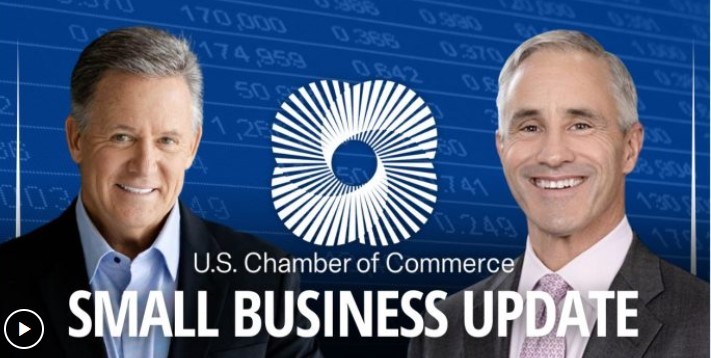
Watch Tom Sullivan talk all things small business with Jim Fitzpatrick on ASBN (America's Small Business Network), including the latest news and policy updates for Main Street business owners. New episodes are added every month so that you can watch them anytime.
Small Business Outlook Podcast
Listen to the Small Business Podc(AI)st for more insights from the U.S. Chamber's Tom Sullivan and NFIB's Holly Wade. Each week, they combine their own expertise with the latest AI tools for podcasting and music editing to deliver an AI-cast that keeps you entertained and up-to-speed on everything small business.
From Main Street


About the author

Thomas M. Sullivan
Thomas M. Sullivan is senior vice president of small business policy at the U.S. Chamber of Commerce. Working with chambers of commerce and the U.S. Chamber’s nationwide network, Sullivan harnesses the views of small businesses and translates that grassroots power into federal policies that bolster free enterprise and reward entrepreneurship. He runs the U.S.


